
Evolution of sport logo's, uniforms,helmets and helmet safety. From design to liability. Introducing DC Sport Theme Helmet Smoking Pipes.
Concept Helmets

Showing posts with label NFL. Show all posts
Showing posts with label NFL. Show all posts
Tuesday, August 23, 2016
Taking Back Sunday - Redefining NFL’s Views On Weed
Source: 420 Magazine

When Kyle Turley was selected with the seventh overall pick in the 1998 NFL draft, he was set along a path that is familiar to too many athletes. After sustaining a leg injury while playing for the San Diego State Aztecs in college, he had begun a regimen of painkillers, anti-inflammatories and other pharmaceuticals that would eventually find him adrift in a post-football existence defined by his relationship to the pills he was constantly advised to take. After quitting these drugs in favor of cannabis, Turley is now a new man, dedicated to helping other athletes witnessing the same darkness.
What are the defining traits of the NFL’s cannabis culture?
It’s the same culture that we see in the concussion discussion, as well. [The League] stands on grounds of ignorance, relying upon science to give them the answers they need. But the only science they continue to adhere to is science that they seem to have a vested interest in controlling. They control their relationships with media and the government in ways that allow them to operate in suspect manners as far as giving information and being held accountable for giving false information.
What do you feel the League can do to change that?
Much like the concussion situation, the cannabis discussion is just another can they’re kicking down the road. To put it one way, while guys are committing suicide and becoming addicted to pharmaceuticals they don’t need - much of this revolves around the NFL’s stance of ignorance. They continue to be a follower instead of becoming a leader when they know they have some very important problems to solve. You have this happening across the country because of sports. Period. Sports are fun and there are a lot of great things that can be had from participating in sports in general, but along with any sport comes athletic injury, which is often very serious. Athletes often require surgery and medication to deal with the pain. And right now they are only being given one choice of medicine. These medicines can often be miraculous for the things they can do, but in the long term they are highly addictive. The truth about cannabis is there for the world to see. Our position should be informed about this, to give cannabis as an option.
When did you first realize it was an option?
My second year in the NFL cannabis was introduced to me by another player - a Hall of Fame player - and it gave me some of the same relief I can still feel today. Dealing with the pharmaceuticals that had been piling up since I blew out my knee in college and I had to have my first surgery, I began to realize that all these pills just didn’t make me feel good. They did a marginal job of dulling pain and inflammation issues, but also did a lot of things to me adversely that I didn’t like. I was going through the rigor of the NFL, being a rookie and second-year player, having a lot of stress to deal with and losing a lot of sleep over the demand of being a professional football player. Unfortunately I was in New Orleans, St. Louis, Kansas City and then I retired in Nashville, so I could only get [the cannabis] I could get from my guy. That didn’t allow me to fully understand the plant, about different strains and their different medicinal effects that I could take advantage of.
Kyle Turley, by then playing for the Kansas City Chiefs, speaks during a news conference at Mike Ditka’s restaurant in Chicago on November 27, 2007, where he presented a check, the equivalent of what he says he earns per game, to an effort to raise money for needy retired players. According to Turley, not enough of his fellow ex-NFLers are being exposed to enough options to treat their myriad physical ailments - and cannabis is part of the solution.

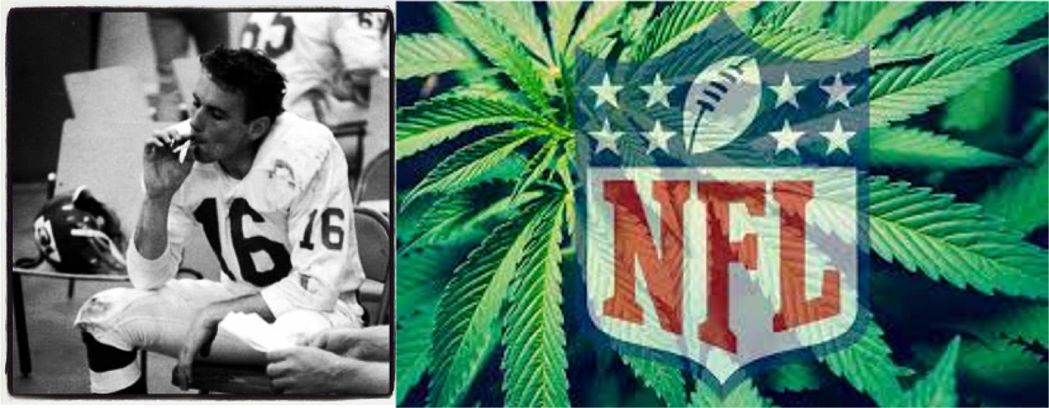
Who is the quarterback from the KC Chiefs smoking a joint?
When Kyle Turley was selected with the seventh overall pick in the 1998 NFL draft, he was set along a path that is familiar to too many athletes. After sustaining a leg injury while playing for the San Diego State Aztecs in college, he had begun a regimen of painkillers, anti-inflammatories and other pharmaceuticals that would eventually find him adrift in a post-football existence defined by his relationship to the pills he was constantly advised to take. After quitting these drugs in favor of cannabis, Turley is now a new man, dedicated to helping other athletes witnessing the same darkness.
What are the defining traits of the NFL’s cannabis culture?
It’s the same culture that we see in the concussion discussion, as well. [The League] stands on grounds of ignorance, relying upon science to give them the answers they need. But the only science they continue to adhere to is science that they seem to have a vested interest in controlling. They control their relationships with media and the government in ways that allow them to operate in suspect manners as far as giving information and being held accountable for giving false information.
What do you feel the League can do to change that?
Much like the concussion situation, the cannabis discussion is just another can they’re kicking down the road. To put it one way, while guys are committing suicide and becoming addicted to pharmaceuticals they don’t need - much of this revolves around the NFL’s stance of ignorance. They continue to be a follower instead of becoming a leader when they know they have some very important problems to solve. You have this happening across the country because of sports. Period. Sports are fun and there are a lot of great things that can be had from participating in sports in general, but along with any sport comes athletic injury, which is often very serious. Athletes often require surgery and medication to deal with the pain. And right now they are only being given one choice of medicine. These medicines can often be miraculous for the things they can do, but in the long term they are highly addictive. The truth about cannabis is there for the world to see. Our position should be informed about this, to give cannabis as an option.
When did you first realize it was an option?
My second year in the NFL cannabis was introduced to me by another player - a Hall of Fame player - and it gave me some of the same relief I can still feel today. Dealing with the pharmaceuticals that had been piling up since I blew out my knee in college and I had to have my first surgery, I began to realize that all these pills just didn’t make me feel good. They did a marginal job of dulling pain and inflammation issues, but also did a lot of things to me adversely that I didn’t like. I was going through the rigor of the NFL, being a rookie and second-year player, having a lot of stress to deal with and losing a lot of sleep over the demand of being a professional football player. Unfortunately I was in New Orleans, St. Louis, Kansas City and then I retired in Nashville, so I could only get [the cannabis] I could get from my guy. That didn’t allow me to fully understand the plant, about different strains and their different medicinal effects that I could take advantage of.
Kyle Turley, by then playing for the Kansas City Chiefs, speaks during a news conference at Mike Ditka’s restaurant in Chicago on November 27, 2007, where he presented a check, the equivalent of what he says he earns per game, to an effort to raise money for needy retired players. According to Turley, not enough of his fellow ex-NFLers are being exposed to enough options to treat their myriad physical ailments - and cannabis is part of the solution.
Ex-USC, Raiders QB Todd Marinovich Arrested Naked with Meth & Weed
Published on Aug. 22, 2016
UPDATE, 10:55 p.m. Aug. 22: Marinovich was also found with methamphetamine, the Los Angeles Times and TMZ Sports reported.

Todd Marinovich, a former USC star and Raiders quarterback, is facing multiple charges after he was found naked with marijuana in someone else's back yard, according to police in Irvine, Calif.
Marinovich was cited for trespassing, possession of a controlled substance, possession of drug paraphernalia and possession of marijuana, the Orange County Register reported.
Police were called to a residence in Irvine, Calif., about 9 p.m. Friday after Marinovich was spotted in the yard. He was carrying items in a brown bag.
“The caller stated that there was a naked person on Venta Spur Trail,” Irvine police Commander Mike Hallin said Monday.
Marinovich, 47, has had multiple drug-related incidents. He was arrested on cocaine possession charges in 1990 and was dropped from the Raiders squad after two seasons for repeated drug abuse. He was arrested in 1997 for allegedly cultivating marijuana and was arrested in 2000 on suspicion of heroin possession.
He was arrested again in 2005 on drug possession charges and in 2007 on charges of felony possession of a controlled substance, unlawful possession of a hypodermic needle and resisting arrest.
Marinovich was drafted 21st overall in 1991 by the Raiders.
Sunday, July 17, 2016
New Chicago Bears Uniforms: Nike Debuts Fresh Blue And Orange Elite 51 Gear (PHOTOS)
After replacing Reebok as the official supplier of uniforms,
Nike and the NFL on Tuesday unveiled a new lineup of jerseys and gear for all 32 teams.
Nike and the NFL on Tuesday unveiled a new lineup of jerseys and gear for all 32 teams.
The Chicago Bears will keep their navy blue and orange colors, of course, but will now
have “newer lightweight fabrics and a sleek silhouette.”
have “newer lightweight fabrics and a sleek silhouette.”
Bears linebacker Brian Urlacher, who modeled the new uniform for Nike,
tweeted about the uniforms Tuesday.
tweeted about the uniforms Tuesday.
“new jerseys are sweet...Classic Chicago Bears look,” he said.
HuffPost Miami has more on the new gear:
While the new jerseys may be “sweet,” they are also quite pricey: a new, game day jersey
will set fans back $250.
will set fans back $250.
Check out the new Bears uniforms here. What do you think? All photos courtesy of
Nike, Inc.
Nike, Inc.
Wednesday, June 29, 2016
Hooked: Jake Plummer opens up about the NFL’s drug problem, offers a solution
By Ryan Koenigsberg on

EDITOR’S NOTE: This is the first in a three-part series stemming from our exclusive interview with Jake Plummer about the drug problem in the NFL, a safe alternative to those drugs, and much more.

EDITOR’S NOTE: This is the first in a three-part series stemming from our exclusive interview with Jake Plummer about the drug problem in the NFL, a safe alternative to those drugs, and much more.
As he usually is around this time of year, former Denver Broncos quarterback Jake Plummer is on a highway between Colorado and Idaho, heading north. He’s on his way to beautiful Coeur d’Alene, located on the north shore of Lake Coeur d’Alene, in the northern tip of the Idaho panhandle.
It’s a summer trip he’s been taking since he was in the fifth grade. That’s symbolic.
It’s symbolic because Jake Plummer is still Jake Plummer. He’s had a serious hip surgery and deals with sharp aches and pains but the 41-year-old man, who retired nearly a decade ago, has not been compromised by his 10-year career in the NFL.
He’s one of the lucky ones.
Painkiller addiction, depression and chronic traumatic encephalopathy (CTE) are just a few of the diseases and disorders that are devastating the lives of current and former football players. Every year, Plummer watches as his friends, teammates and colleagues fall upon dark times and into deep addictions due to the effects the game has on the mind and the body, on top of the habits they learned in the league.
It hurts him to watch.
“I have a hard time with it because everybody says, ‘Oh, poor NFL millionaires. Oh, you poor people.’ They don’t understand,” he says to BSN Denver from the highway. “Maybe they should have a little more to say about the owners that are billionaires, they’re not millionaires; they’re billionaires.”
“Like Jerry Jones, who says it’s ‘absurd’ that there would be a link between brain trauma, football and CTE,” Plummer adds. “Shame on him for saying that, that billionaire asshole. It’s the worst thing in the world for a guy like that to say. That’s where we’re sitting; grown-ass men are asked to go out there for millions of dollars—which, yeah, it’s a lot of money—bang themselves around and completely fuck their lives over for their 40s and 50s. So yeah, poor football players is what I say. If you’re a grown-ass man, you should be allowed to make grown-ass decisions.”
Grown-ass men being able to make grown-ass decisions is what Plummer believes in.
“They should be able to say, ‘I’m going to have some CBD and puff on this fatty, relax after a football game and take the pain away,'” he says. “Not get tested for it like Josh Gordon, who now can’t play the game that he’s been playing since he was a kid because he smokes marijuana. It didn’t derail him or cause him to underachieve from what I witnessed. He dominated the league for two straight years, and now he’s out of the league because he chose an alternative form of medicine.”
An alternative form of medicine is what it’s all about.
The aforementioned CBD or Cannabidiol is one of 113 cannabinoids or compounds found in cannabis, the plant, of course, known for producing THC, the psychoactive ingredient in marijuana. CBD, though, is non-psychoactive as well as non-addictive and non-toxic. It’s a naturally-occurring anti-inflammatory that has also shown to be effective as an antidepressant, anxiolytic (anti-anxiety) and a neuroprotectant which slows the loss or neurons and protects the brain from traumatic injury and neurodegenerative diseases like CTE.
Plummer takes CBD every day.
Again, though, he’s one of the lucky ones. He can take CBD because he isn’t in the league anymore. He also never developed an addiction to painkillers. CBD contains extremely subtle traces of THC, traces low enough that you would never get high but high enough that an NFL player could be at risk of testing positive for a substance that is still banned by the league.
Current players are left to work with the dangerous substances that are allowed by the league instead, and they can’t afford not to.
“It’s really hard to explain to the outside because it’s like having a job and there’s constantly people coming to take your job,” Plummer explains. “If you’re in pain, and you can’t perform or if you’re not healthy then someone is going to take your job.”
“I know a lot of guys that were using [percosets]and [vicodins]if that’s what they had to do to get through an NFL season,” he adds. “At that point, I wasn’t going to be the guy to say, “Hey man, this stuff is bad for you.” I knew it was; I knew they knew it was but your job is being threatened and you’re going to do whatever it takes. There was, still is and always has been a pretty high use of whatever drug of choice it is to keep you on the field.”
They know it’s bad for you, and while the NFL and NFLPA have come a long way regarding the education of players in terms of what they’re doing to their bodies, it’s not clear if they know exactly how bad for you.
“It’s hard to say that they’re getting information given to them, I don’t know if the head trainer gets up in front of the team and says, ‘Hey, if you get hurt we’re going to be giving you these opioids, and they’re narcotics. It’s basically really nice, really good heroin and we’re going to give it to you so you can go out and actually damage your body even more and we’ll insure you for a few years afterward, but then you’re on your own.'”
Some may know, some may not but either way they take ’em and they take ’em and when they leave the game, they take ’em some more.
“Everybody deals with pain whether you played in the NFL or not, there are a lot of people that are in pain on a daily basis,” Plummer explains. “But the effects that the game has on your body and the effect it has on your brain, we might not be as well suited to deal with that as the rest of normal society. Some of these guys might have some mental problems from banging their heads against each other, and they need that pain to go away. When you’ve been taking these pills for so long, you don’t just take one, you eventually move to two and then three because you don’t feel the same effects of it anymore. That’s the real scary part.”
It turns from taking the pain away so you can play to a full-blown narcotics addiction.
“I’ve known quite a few guys with addictions, they’re not down and out or necessarily on the end of their ropes, but some of them have been,” Plummer says. “Some of them have gone through the rehab process, and they’re doing better now but some of them, to this day, continue to take the pain meds because, to them, it’s what helps dull that pain.”
Now, Plummer is dedicating his days to trying to save his teammates, his friends, and his rivals. Attempting to educate the football community about the uses of CBD as an alternative form of medicine for former players, and ultimately hoping to prove to the league that CBD should be permitted for current players.
Nate Jackson, Jake The Snake’s teammate with the Broncos, introduced him to CBD. He also introduced his quarterback to Ryan Kingsbury and Joel Stanley, two of the many men involved in the Realm of Caring’s “When the Bright Lights Fade” campaign. The group is planning to conduct studies with research universities such as Johns Hopkins in hopes of determining whether CBD can truly help current and former NFL players improve their quality of life and, in some cases, save their lives entirely.
The former pro-bowler is all in.


“This job is amazing, man,” Plummer exclaims vibrantly. “My job is to reach out to old teammates, reconnect and let them know I still care about them, that I still love them. . . I’m excited to reach out to more and more guys, even opponents and all kinds of players that I know are at that point where it’s like, ‘Man, I don’t feel good, and I’d like to feel better.’ All their doctor does for them is give them a laxative or a pill that makes them poop, and they’re taking narcotics so they’ll probably feel better after they poop, but they’re not going to feel better really until they try something different. If CBD is right for them, hopefully they give it a shot, and it’ll do what it’s done for me—help them feel a lot better and just feel good about where they’re at.”
On top of raising money to research the entirety of the effects CBD can have on the adult male When the Bright Lights Fade is hoping to conduct a different study on current players.
“We want to test every single player—if we can—in the NFL this year to see what they supplement,” he says. “What they take, how they feel, how their body reacts, how they sleep, how they recover. Then we can understand how many guys not only smoke marijuana, which is a banned substance—people say 50-percent. How many? I don’t know, but I know it’s out there.”
“I know there are guys that are using CBD in the league, also,” adds Plummer. “There are guys who can think for themselves, who can read something other than an Instagram caption or a tweet. These guys go online, they read, they find something like this, and they feel okay that they aren’t putting their career at risk. They’re taking it already. It just has to be approved, it’s gotta be decriminalized, taken off the banned substance list, which should happen soon, that’ll help out a lot.
It seems obvious.
“I just don’t see anything wrong with allowing grown men to take something that’s going to help them and quite possibly save the game.”
TO BE CONTINUED: In part two of our conversation with Jake Plummer, we’ll address why the league has such a strong stance against marijuana, how long it may take for the league to change, and what Plummer and the rest of the “When the Bright Lights Fade” campaigners are doing to speed up that process.
Thursday, May 19, 2016
90% of Native Americans Not Offended by Washington Redskins Name
Poll proves Redskins "debate" whipped up by perpetually offended media
May 19, 2016Ninety percent of Native Americans aren’t offended by the Washington Redskins name, underscoring how the “issue” has been hyped up by both the perpetually offended media and politicians trying to control free speech.
The Washington Post – a liberal newspaper – conducted a poll of over 500 Native Americans across the country and found that the general population is more concerned about the so-called “racist” Redskins than the group the team is supposedly offending.
Even more, of the Native Americans who identified as being liberal, 80% of them called the name “inoffensive.”

And, giving the poll more credibility, a 2014 ESPN poll found that only 23% of the population supported a name change, and it’s likely only a small percentage of that 23% were Native American.
"The Washington Redskins team, our fans and community have always believed our name represents honor, respect and pride. Today's Washington Post polling shows Native Americans agree," team owner Dan Snyder said in a statement. "We are gratified by this overwhelming support from the Native American community, and the team will proudly carry the Redskins name."

And it also served as a chilling effect on free speech because “political correctness” encourages self-censorship by exploiting the human fear of social rejection.
“When a free society falls under the sway of these manufactured cascades, many people stop behaving as free thinkers,” former intelligence insider Stella Morabito said. “People become less focused on truth and more focused on their social survival, and once people perceive the PC view as dominant, many with opposing views remain silent out of fear of social isolation.”
In other words, people will fear sharing their views and opinions out of fear they’ll be socially outcast like a leper due to not being “politically correct.”
This, of course, suppresses civil debate that awakens reason and causes people to challenge the current political system.


Saturday, March 26, 2016
Tuesday, January 19, 2016
Tuesday, October 6, 2015
Bye-bye Raiders? New L.A.stadium gains NFL owners' support
Los Angeles hasn't had an NFL team since the Rams and Raiders departed after the 1994 season. Now they want to resume their L.A. story, and the Chargers are looking to leave their home city since 1961.
"Those are the circumstances as they are," he said. "You take a risk if you file for relocation of whether it'll be approved."

The Chargers and Raiders, long-time AFC West rivals, are pushing a shared $1.7 billion venue involving about 170 acres in Carson, a city of 93,000 people south of downtown Los Angeles. Owners Dean Spanos of the Chargers and Mark Davis of the Raiders spoke during their 30-minute presentation at the meetings, and Carmen Policy, a former 49ers executive who was hired to help oversee the project, said the group touted the transportation and location advantages of its proposed site, and the history of the teams.
"It cures the California dilemma and you're not only curing the California dilemma, but you're curing it with California teams," Policy said. "These teams have been born and bred in California. They never left California. They've always been in California."
Davis said he talked about the progress that the group had made over the past six months, and he thought the presentation went well.
"You never know," Davis said. "As I've said all along, Oakland is still the place that we wanted to be and we'll just see what happens."
The city of San Diego had its chance to speak to the NFL on Monday, making a presentation in front of the league's Committee on Los Angeles Opportunities. Then the city and county unveiled updated plans for a new $1.1 billion stadium that were criticized by the Chargers.
Eric Grubman, the NFL's point man on relocation, said the city's proposal "evidenced a significant amount of progress," but the committee still had several questions about possible risks and threats. The Chargers have expressed concerns about an environmental study collapsing in court.

"Those questions remain open," Grubman said. "They are working on responses and how to mitigate those risks."
Sunday, September 20, 2015
Tuesday, September 8, 2015

Subscribe to:
Posts (Atom)